To round out a project-filled semester, my digital portfolio is complete! My portfolio includes information about myself, my career aspirations, work samples, and my resume.
http://amyclawrence16.wix.com/amylawrence
Showing posts with label Digital Media. Show all posts
Showing posts with label Digital Media. Show all posts
Monday, December 16, 2013

Monday, November 4, 2013
Once Upon a Digital Story
Osgood and Hinshaw write an entire book on Visual Storytelling, but for our
purposes their chapter on “The Aesthetics of Editing” serves the most
purposeful for our class. As we
begin our video projects, the authors offer helpful tips on how to edit video
effectively.
Director Louis Malle is quoted in the chapter as saying, “I
keep telling my editors, if you win an award for editing, I won’t work with you
anymore. Your editing shows,” (230).
The cardinal rule of editing is to be sure the viewer isn’t aware that
the story is being cut, as the story should flow so naturally that a viewer
does not have time to consider whether or not the editing is quality or subpar.
Have
you ever noticed the editing as a viewer?
Do you notice it because it is excellent editing or poor editing?
Osgood and Hinshaw identify several aspects of good editing
to consider when cutting a video.
- Image and Sound
- Shot Order
- Shot Relationship
- Time
- Rhythm and Pacing
Additionally, transitions are critical to high quality
editing. A transition is “the fundamental action that advances a
story line from shot to shot and scene to scene,” (240). There are three major techniques when
cutting:
- Cut on dialogue
- Cut on action
- Cutting on the beat
Sequencing is another characteristic of first-rate
editing. “The purpose of the
sequence is to add interest and sophistication to a scene and provide the
viewer with a better understanding of the scene,” (239). Different shows utilize different
sequencing techniques because those patterns work for their material.
Rachael Ray’s Thirty Minute Meals uses close up shots so that viewers can see how
the chef whips up her favorite dishes in thirty minutes. Displaying the cooking process in close
ups makes it more appealing to viewers.
Check out Rachael making BLT Burgers with Sriracha Aioli below.
Wednesday, October 2, 2013
Before and After: Technology at Furman
 |
| Before: Dark glow |
 |
| After: Brighter, sharper |
 |
| Before: Overexposed |
 |
| After: Darker Contrast, All Black Screens |
 |
| Before: Overexposed, Wide Shot |
 |
| After: Zoomed in, Colors Darkened |
 |
| Before: Wide Shot, Bright Image |
 |
| After: Cropped, More Contrast |
 |
| Before: Underexposed |
 |
| After: Brightness increased, T added |
Monday, September 30, 2013
Composition Matters...Or Does it?
Chapter six from Reading
Images, written by Gunther Kress and Theo van Leeuwen, discusses “The
Meaning of Composition” in images, advertisements, television shows, and other
mediums. Kress and van Leeuween
make several convincing arguments regarding the composition of images that we
see on a daily basis. I had never
heard of the “rules” they advocate, and after researching a bit I found it
difficult to accept their theory.
Kress and van Leeuween argue “a theory of language is no
longer sufficient and must be complemented by theories which can make the
principles of the new visual literacy explicit” (Kress). They address their theories with three
directives of composition. According
to the authors, “Composition…relates the representational and interactive
meanings of the image to each other through three interrelated systems”
(Kress):
- Information Value: The location of images associate them with their informational value
- Salience: The images must draw the attention of viewers and prove their relevance
- Framing: Including or omitting framing devices shows importance to other items nearby
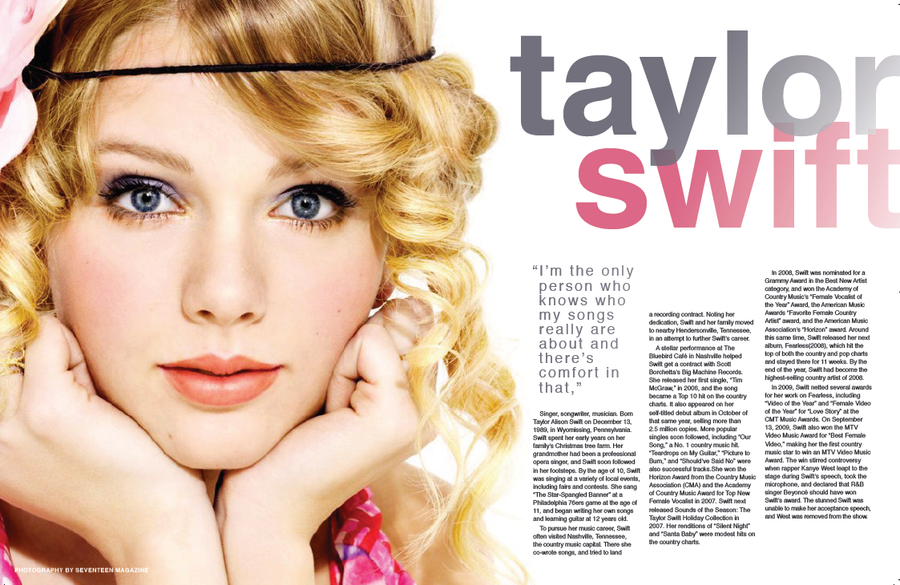
In some mediums with a divide down the middle of
the image, the left side of the image is the “given” and the right side is the
“new.” For instance, in this
Taylor Swift feature in Seventeen Magazine, the singer is placed on the left
side of the page as a familiar face, while the article and new information on
the music star are on the right.
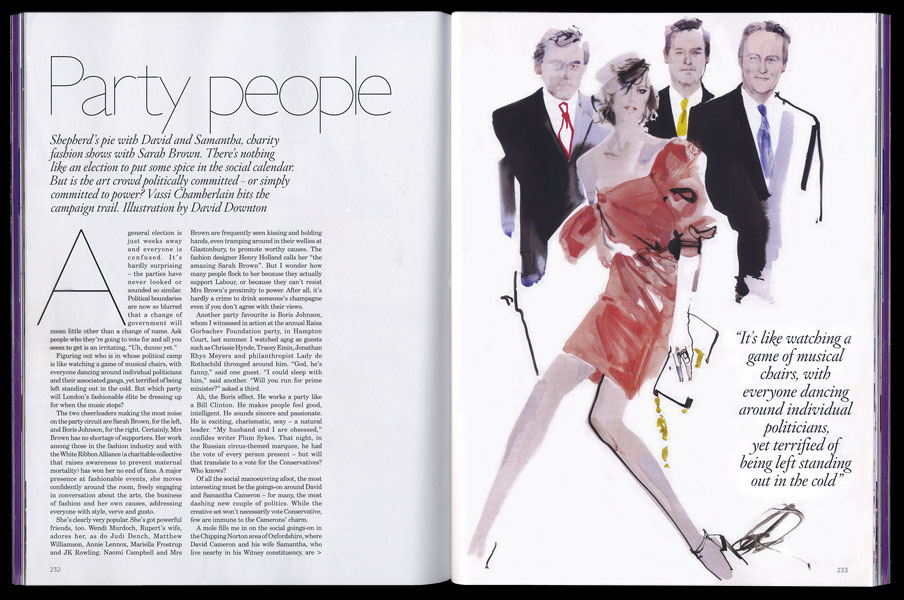
However, there are plenty of popular images that do not fit
within the constraints of the authors’ rules. Oprah, Jay Leno, Jimmy Fallon, anchors on CNN, magazine
spreads in Vogue, and the like do not follow this theory. In fact, I had a more difficult time
finding images that did fit into the
criteria than those that did not. Do you think the authors’ theory is
followed or merely a suggestion of how images should be compiled? Are
images that do not fit within the constraints of the theory as aesthetically
pleasing to you as images that do? See below examples that defy the theory set out by Kress and van Leeuwen.
 |
| Vogue Magazine spread |
 |
| Nike advertisement |
Monday, September 9, 2013
The Digital Public Sphere
A shift in our new media age is obvious. What isn’t necessarily clear is how that transition occurred. People used to cherish their black and
white newspaper like a new puppy on Christmas, yet Americans today spend as
little as half an hour a day reading that same newspaper. Many communications experts, including
Rettberg, attempt to explain this phenomenon as it continually impacts our
society today.
Rettberg writes in chapter 2, “We have moved from a culture
dominated by mass media, using one-to-many communications, to one where
participatory media, using many-to-many communication, is becoming the norm.” Our culture believes strongly in
democracy as it applies to our everyday lives in that people are permitted, and
often encouraged, to participate in a social conversation with others. Walter illustrates this as a human’s second orality. Blogs enable a constant flow of
information among strangers with similar interests. Since blogs encourage an informal tone and language akin to
everyday speech. This second
orality is one that Internet users use on a daily basis, as we stretch ideas
into the digital public sphere. Does this second orality correlate with the skill set Ulmer refers to his in article on Electracy?
The Modern Public Sphere was an idea originated by Jurgen
Habermas in his work The Structural
Transformation of the Public Sphere.
Rettberg summarizes Habermas’ Modern Public Sphere as an “ideal
democratic space for rational debate among informed and engaged citizens, a
space that would thus be an arena mediating between state and society.” Last semester, I took Political
Communications with Dr. Letteri and read Habermas’ work in its entirety. Drawing on my knowledge from that
course, I further understand that the best way to democracy is through critical
rational debate. Habermas explains
the evolution of the public sphere from coffee houses and taverns to the
bourgeois society parties. This
public sphere eventually becomes public opinion, which continues to be held in
high regard today. Digital media
allow for a quicker response and a more diverse audience of bloggers and
readers. How is the modern public sphere altered by the digital world?
Rettberg’s third chapter hits on the speed of blog posting
and commenting as one of its most beneficial keys to success. The pace of which information is shared
is rapid and allows for ideas to develop quickly. However, the speed of transmitting the information does not
have to be instantaneous. For
example, a friend may comment on your social media Facebook site a mere three
minutes after you post an interesting article from the New York Times. However, three weeks later another
friend may find that you posted the article and have an opposing opinion. The beauty of the Internet is not only
its rapidity, but also its continuity.
Stories continue to be posted for other readers who may find interest in
the article at a later date. The visibility of social networks, such as
in this example, matter to the audience.
Visibility is what gives Facebook, LinkedIn, Google+, blogs, and MySpace
its fame. They are seen by readers
and can be referred back to the same page in the future.
Monday, September 2, 2013
Keeping It Short and Simple
Brian Carroll’s chapter, “Digital Media Versus Analog Media”
details the novel transformation our society has experienced from print media
to digital media. Our new digital
media allows for interaction with the media, not merely a reading of it. Readers can participate in digital
media, comment, and contribute their own ideas into the digital public
sphere. However, Carroll considers
good writing as the key to a successful Web. Good writing from reliable sources enables readers to trust
the source. In digital media, and particularly
news sites, credibility and trustworthiness are the most important factors in
the source’s success. Without
credibility, what edge does the source offer its audience? This being true, how does a news source
establish credibility to their readers?
For example, what characteristics make CNN a reliable news source?
An expression coined by Marshall McLuhan, “The Medium is the Message” relays the belief that often the characteristics of the medium in
which information is transmitted is more important that the information
itself. As it relates to Carroll,
timeliness and brevity are two crucial characteristics within the medium that
really matter. For news sites such
as Fox News and CNN, often it is the source that gets a breaking news story out
first that receives the most credit,
proving that when readers receive
said news as an important factor.
Additionally, brevity matters to readers as well. Jakob Nielsen reported, “Web users read
about 25 percent more slowly on screen than on paper.” This data encourages the use of
concise, clear statements on digital media including tweets, headlines, and
breaking news alerts. Mantras such
as “WWGD: What Would Google Do?” further promote digital media creators to
write concisely on the Web.
Keeping within the constraints of how Google operates on a daily basis,
Carroll suggests using key words as starting points for headlines,
sub-headlines, and hyperlinks in order to grasp attention of readers.

Carroll devotes an entire chapter to creating an effective
website through the use of screen writing tips. One central suggestion is to write in plain English. Since websites are often translated
around the global world, it is crucial that the wording be straightforward and
simply understood. Keeping in line
with the simplistic mentality, Carroll advocates for minimalistic websites in
which less is more. Since websites
are created as a vehicle for information, it is important that a reader can
quickly establish an identity and mission of the website, as well as provide
shortcuts that quickly convey the big picture of the website creator’s
ambition. I agree with Carroll’s
major points in this chapter as I imagine the websites I frequently explore. As a reader, I enjoy simply designed
and colorful websites that are easy to navigate. Shortcuts further endorse quick and reliable Web surfing. As an ordinary person with limited
technological knowledge, I appreciate website designs that aim to make my
information search quick, successful, and painless.
Wednesday, August 28, 2013
The Rise of Digital Media
In the article, “Is Google Making Us Stupid?” Nicholas Carr
lays the foundation for a compelling argument regarding how the Internet has
managed to rework the wiring of our brains. He dives into a newfound human tendency that suggests
attention spans are shortened due to ease of access to a plethora of sources
from all around the Internet.
Initially, I’m offended. I
read what I deem to be thousands of pages of material for my classes each
semester and produce papers, projects, and presentations for said classes. But for every novel, there is a related
Sparknotes book published online; for each online journal article, there is an
abstract; and for each Google search there are related keywords and similar
searches. Carr asserts: “The advantages of having immediate access to such an
incredibly rich store of information are many, and they’ve been widely
described and duly applauded.” The
Internet has undoubtedly made our lives easier, but does that mean it has necessarily
made us stupider? Who might this level
playing field of knowledge disadvantage?
Reading news headlines, breaking news alerts sent to one’s
iPhone, and Wikipedia searches are habitual actions that belong to the new
generation. But does a generation
of skimming rather than reading impact our democracy? Carr also advises that even newspaper fanatics can read a single
page of top news stories in the New York Times, without having to thumb through
the entire newspaper. Does being
the “skimming generation” make us less informed than previous generations who
tediously read every word of the daily paper? Admittedly, I subscribe to a news summarization site that
sends me an email early each morning with the top stories and key facts for the
upcoming day. Coincidentally, that
site is appropriately titled: “The Skimm.” Until now, I merely thought I was minimizing the time it
would take me to read a newspaper and not once have I stopped to contemplate
the significance of my actions.
Reflecting seriously upon my daily Internet usage, I’m guilty again. While reading the article, I managed to
take a quick detour to both BuzzFeed and Pinterest. I frequently end up seeing the film production of the book
before I can finish the novel that the movie was based off of. I believe that if someone were to put
an iPad in front of me, I would instantly open the Safari app to begin searching
the web, rather than opening the Kindle app. These examples relate to the theory of electracy, as
described in Ulmer’s article.
“’Electracy’ is to digital media what literacy is to alphabetic writing:
an apparatus, or social machine, partly technological, partly institutional,”
according to Ulmer. Perhaps
electracy is to blame for the changing environment of our digital media intake,
but I believe it is also revolutionary.
The skill set necessary to transmit and receive digital media is one
that will be studied for many years to come, and will be diligently taught to
future generations.
Hello, World
"Tellin' it like it is" is a phrase often heard to describe gentle, realistic, or sometimes just downright brutal honesty. Known to my friends as the one to assuredly divulge my honest opinion, I aim to maintain the same truthfulness in my blog. As I try my hand at blogging, I felt it necessary to approach the modern, digital public sphere in a way akin to my real life.
This past summer, I interned on Capitol Hill in Washington, D.C. for the House Committee on Oversight and Government Reform. My second summer in Washington, I was granted an unbelievable opportunity to intern in an office that shed light on the inner workings of our government and directed reforms to better our nation. While I certainly ran my fair share of errands, tediously proofread lengthy bills, and made an unthinkable number of copies, the experience was simply irreplaceable. I learned more about our government's operations and daily activity in one summer than I could have ever imagined possible. After graduation, I hope to land a highly coveted position on the Hill and ultimately work as a legislative assistant or a press secretary thereafter.
From this class, I desire to gain a basic understanding of digital communications and how it can apply it to practical careers post-graduation. With aspirations to be a press secretary for a congressman or campaign, a knowledge of effective blogging techniques, video editing, and creating digital media posts or videos will improve my skills to achieve successful career in the press field. Potential blogging topics of interest to me include technology on Furman's campus, social media on college campuses, and the up and coming Greenville (detailing all things new to Greenville).
This past summer, I interned on Capitol Hill in Washington, D.C. for the House Committee on Oversight and Government Reform. My second summer in Washington, I was granted an unbelievable opportunity to intern in an office that shed light on the inner workings of our government and directed reforms to better our nation. While I certainly ran my fair share of errands, tediously proofread lengthy bills, and made an unthinkable number of copies, the experience was simply irreplaceable. I learned more about our government's operations and daily activity in one summer than I could have ever imagined possible. After graduation, I hope to land a highly coveted position on the Hill and ultimately work as a legislative assistant or a press secretary thereafter.
From this class, I desire to gain a basic understanding of digital communications and how it can apply it to practical careers post-graduation. With aspirations to be a press secretary for a congressman or campaign, a knowledge of effective blogging techniques, video editing, and creating digital media posts or videos will improve my skills to achieve successful career in the press field. Potential blogging topics of interest to me include technology on Furman's campus, social media on college campuses, and the up and coming Greenville (detailing all things new to Greenville).
Subscribe to:
Posts (Atom)